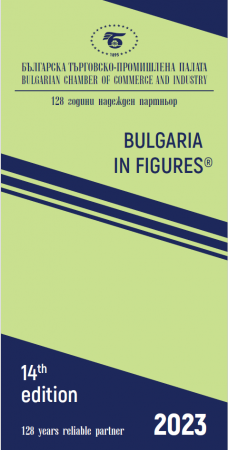

“Bulgaria in figures®” 2023 is now available

July 28, 2023

The 14th edition of the brochure “Bulgaria in figures®” 2023 is now available. The Bulgarian Chamber of Commerce and Industry (BCCI), a licensed WTC Sofia (AF),  gathered and processed information that reflects the main macroeconomic indicators of the country for the period 2018-2022. The brochure pays special attention to Bulgaria's place in 27 international rankings - an important reference point for foreign investors.

As a business support organization, BCCI aims at presenting Bulgaria’s achievements in various sectors and international rankings, attracting more investments and creating new partnerships.

In 2022, the country's GDP reached 84.5 billion euros, which is the highest level so far, with GDP growth of 3.4%. Unemployment remains low at 4.3%, approaching pre-crisis levels (4.2% in 2019). Inflation rate in 2022 reached 15.3%. It is expected to decrease gradually in 2023 and in 2024 to return to healthier levels.

Bulgaria is a leader in terms of the tax system in the EU with 10% corporate tax and this is one of the main competitive advantages that the country offers. A substantial factor for every investor is the possibility of applying 0% corporate tax in municipalities with over 25% above the country average unemployment rate /165 municipalities out of 265 as of 2022/.

Despite the high inflation, the Bulgarian companies are increasingly involved in the rearrangement of the supply chains, evidenced by the record export flow for the last 15 years of Bulgaria in 2022. According to National Statistical Institute data, it is worth 48 billion euros /37% growth/. Expectations for 2023 are for even better results, but at a reduced profit margin for businesses. Bulgaria's leading trade partners in terms of exports are again Germany, Romania and Italy, which form about 50% of Bulgaria's exports to the EU.

Imports of goods and raw materials registered record levels in 2022 with a growth of 41% compared to the previous year and a level that amounts to slightly more than 55 billion euros, with the trade balance again remaining negative for our country.

An electronic copy of the brochure in English could be found at the following link - https://www.bcci.bg/resources/files/BCCI-Bulgaria_in_figures-2023.pdf. 

More News

BCCI presents "Bulgaria in figures" 2025

August 1, 2025 - The Bulgarian Chamber of Commerce and Industry (BCCI), WTC Sofia AF, has once again prepared and officially presented the traditional 16th edition of "Bulgaria in Figures®" 2025 in English, driven by the desire to provide information to all who have chosen Bulgaria as a partner and investment destination. The publication reflects key macroeconomic indicators of Bulgaria over the past five years, including the investment environment, tourism, imports and exports, education, and the labor market, as well as other important aspects of the Bulgarian economy. Special attention is given to Bulgaria’s position in the international rankings, which can serve as an important guide for investors. Specific areas of progress, as well as critical positions of Bulgaria in these rankings, are highlighted. The Bulgarian economy continues its growth from recent years, albeit at a slower pace. GDP: In 2024, GDP growth was 2.8%, due to global economic and political challenges, including the conflict between Russia and Ukraine and the tensions in the Middle East, and their impact on the European economy. Labor Market: The unemployment in Bulgaria remains at a low level of 4.2% in 2024, resulting from the efforts to preserve jobs and measures taken during the pandemic. The labor market remains stable, with a slight increase in the employment rate to 70.9%. Tax System: Bulgaria continues to maintain one of the lowest tax rates in the European Union, with a flat tax of 10% on personal and corporate income. In Bulgaria, taxpayers are exempt from paying corporate tax in regions with high unemployment levels. In 2024, approximately 61% of municipalities—162 out of a total of 265 in Bulgaria—had unemployment rates 25% higher than the national average and 0% corporate tax rate. At the same time, Bulgaria maintains financial stability, with the country's gross public debt being the second-lowest in the EU27, reaching 24.6% of GDP in the third quarter of 2024, and 24.1% by the end of 2024. As of the end of May 2025, the national debt stands at BGN 53,775.7 million, or 24.6% of GDP. As of Q1 2025, Bulgaria has the lowest debt-to-GDP ratio in the EU. The "Bulgaria in Figures" brochure also provides data on inflation, foreign trade in goods, wage dynamics, tourism, and the latest macroeconomic forecasts. Bulgaria's Rankings in International Indices (as of June 2025) In 2024, the country made significant progress in: Prosperity and Freedom Index (from 75th to 53rd place) Human Development Index (HDI) (from 70th to 55th place) Energy Transition Index (from 48th to 36th place) Global Peace Index (from 31st place in 2023 to 26th place in 2024) The country registers decline in: World Press Freedom Index (from 59th to 70th place) Corruption Perception Index (from 67th to 76th place) Economic Freedom Index (from 43rd to 52nd place) The latest data from June 18, 2025, from IMD – Switzerland, on global competitiveness, where BCCI is a partner in Bulgaria's 2025 study, shows that the country's position has improved by 1 point (from 58th to 57th place), now compared to 69 countries studied, instead of 67, which can be noted as a slight improvement. BCCI's Role and Services The publication also highlights key data about BCCI and the services it provides to the business. The edition has been well-received by the business community and is distributed among official Bulgarian and foreign institutions, embassies, Trade and Economic Affairs Offices (ТЕАОs), international partners, numerous companies, and participants in forums and international events. The "Bulgaria in Figures®" edition is available in both print and as a free electronic version here. Read More

WTCA Europe Regional Conference was held in Sofia

July 29, 2025 - In the three days between 15 and 17 June 2025, Sofia was the meeting point of leaders in industry, innovators and visionaries who gathered from the whole of Europe. More than 30 representatives of the World Trade Centers in Armenia, Bulgaria, Bosnia and Herzegovina, Great Britain, Germany, Ireland, Spain, Cyprus, the Netherlands, Poland, Portugal, Romania, Serbia, Turkey and France participated in thematic seminars and presentations of world-famous lecturers who shared their views on the latest trends and future developments in the field of real estate and global trade. The event was opened by Tsvetan Simeonov, President of BCCI, WTC Sofia AF, who welcomed colleagues from 15 countries. The meeting was part of marking the 130th anniversary of the establishment of the Bulgarian Chamber of Commerce and Industry. The meeting was also attended by the newest members of WTCA (the World Trade Centers Association), coming from Europe – the WTC Belgrade and WTC Sarajevo. The President of BCCI granted Licences to the two World Trade Centers on the first day of the European meeting. The second day of the Conference included holding interactive workshops and panel discussions, intended to provide practical knowledge and innovative solutions to the challenges, faced by companies today. The focus was on the sectors of the automotive industry, energy and renewable sources, as well as artificial intelligence. The management of World Trade Center Sofia acquainted the colleagues with its activities - renting out offices, commercial areas, parking lots and conference halls, as well as in organising business meetings and trade missions and providing services, intended for the business sector. In Sofia Tech Park, the participants in the meeting saw a Laboratory for producing prototypes of robots used in industry. They got acquainted with a supercomputer, called DISCOVERER, which is among the leaders in terms of its computing power. The Meeting’s Programme also included a discussion of the opportunities in Europe for regional integration and economic development, presented by Dr Krassen Stanchev, an Economist, Founder and Chairman of the Institute for Market Economics and Member of the BCCI Board of Directors. He examined the current political uncertainty worldwide as a factor, affecting the economy of Europe and the region. The role of the European World Trade Centers in regional integration and economic development was presented by Nicholas Beaty, Coordinator of the Rennes Bretagne World Trade Center, and Patricia Moinard from WTC Metz-Saarbrücken. During the last day of the meeting of representatives of World Trade Centers from Europe, hosted by the BCCI, the discussion continued on recent and important topics for the participants. The possibilities for multifunctional use of buildings and real estate within the world trade centers were discussed during a thematic panel. Ahmed Nasser, founder and director of the company Antika World presented the transformation of the Central Department Store in Sofia and discussed with the participants good practices in other countries and world trade centers for multifunctional use of business buildings. At the end of the conference, the President of the Bulgarian Chamber of Commerce and Industry, World Trade Center Sofia - Associate, Tsvetan Simeonov thanked the participants for their active presence within the meeting and passed the baton to the next WTC, host of the European conference. The next European regional meeting will be hosted by WTC Ballerup, Denmark. Henriette Berk Persson, CEO shared elements of the meeting program in 2026. in an innovative location focused on national and international trade exchange in the Copenhagen region. The World Trade Center, which will host the meeting in 2027 – in the Armenian capital Yerevan – was also presented. Read More