The Emerging Emeralds in International Trade

February 28, 2023

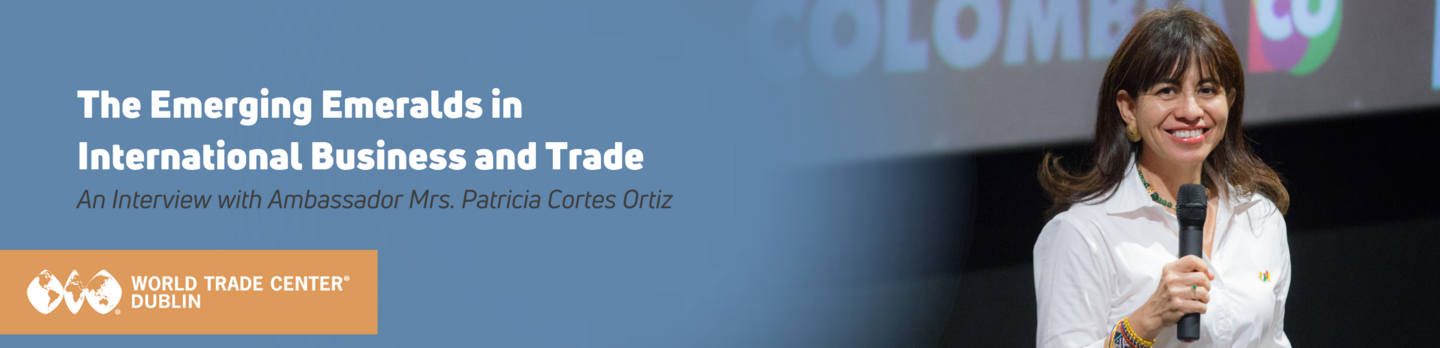
A Conversation with Her Excellency Mrs. Patricia Cortés Ortiz, Colombia Ambassador to Ireland

The Colombia – Ireland relationship dates back to the 1800s from the time over 2,000 Irish volunteers accompanied Simon Bolivar in the campaign in which Colombia gained independence from Spain, including Cork man, General Daniel O’Leary who was aide-de-camp to Bolívar. Once the wars of Independence were over, a good portion of the volunteers remained in Colombia, some as part of the Colombian army, others to integrate into society as businessmen, merchants, artists and miners. Though academic sources differ, it is estimated that the Irish diaspora in Colombia is 10,000 people at present. There are around 700 Colombians that live and work in Ireland today.

It is without a doubt that the long history between the two countries has only strengthened in recent years with the opening of the Colombian Embassy in Dublin in 2018, the Irish Embassy opening in Bogotá in 2019, and alongside Global Ireland, Ireland’s strategy for Latin America and the Caribbean to 2025.

 With thriving businesses and business professionals that are keen to increase activity, the World Trade Center Dublin and the Embassy of Colombia are pleased to announce our partnership this year with a focus on increasing trade activity and trade relations between the Emerald Isle and the Land of Emeralds.

The Embassy of Colombia in Dublin opened its doors in 2018. Can you share an overview of the Embassy and how the first years of establishing the Embassy have been? What challenges and successes have you seen?

Colombia and Ireland have developed a strong and multifaceted relationship. We share values and common experiences related to peace. Our bilateral agenda has grown stronger since the visit of President Michael D. Higgins in 2017 and the opening of our embassies in Dublin in 2018, and Bogotá in 2019.

I was posted to be the first resident Ambassador of Colombia to Ireland, and Ireland has been a very welcoming post, so we have been fortunate to diversify our bilateral agenda extensively and to strength our people-to-people connections and links. One of the great successes we can account The Emerging Emeralds in International Business and Trade A Conversation with Her Excellency Mrs. Patricia Cortés Ortiz, Colombia Ambassador to Ireland 7 for is the high-level political engagement throughout this period. The first visit of a Colombian Foreign Minister, in the 20 years of relationship, occurred in September 2019 with the presence of Colombian Foreign Minister, Carlos Holmes Trujillo. Last year the Tánaiste, Leo Varadkar, visited Colombia on St. Patrick’s Day and our Former VicePresident and Foreign Minister, Marta Lucía Ramirez, visited Ireland in April. Our current Minister for Agriculture, a key portfolio in President Petro’s administration, visited Ireland last September.

n business, the creation of the first IrishColombian Business Network initially formed by 14 companies keeps growing; and the bilateral trade is diversifying steadily. We also expanded the scope of cooperation to include areas like agriculture, education, science, and innovation.

 Additionally, I can see the difference in the media coverage of Colombia in Ireland; there has been progress in dismantling stereotypes. This remains an area we work in every day, which can only be changed through dialogue, communication, education, and cultural exchanges.

The only obstacle for a more fluid bilateral relationship is the short-stay visa requirement by Ireland to Colombia. Currently, Ireland is the only country in Europe that requires a visa for Colombians which remains a main barrier to expanding our economic and people-to-people ties. Though, based on the facts and the many aspects we have in common with Ireland, we are very hopeful about this requirement being lifted soon.

The EU-Colombia Trade Agreement has been in place with Colombia since 2013 and has certainly led to the increase of exported products from Ireland to Colombia and vice versa. Please share some insights into Colombian trade, what sectors and businesses are performing the best in both markets, and what you envision will help progress and increase the activity between the two countries?

The signing of the 2013 agreement undoubtedly made the trade links more robust. Another milestone was the opening of the Embassies in Dublin and Bogotá. This allowed us to work together with Ireland to diversify the exports –the mining sector had been traditionally the most significant exporter from Colombia to Ireland– and increasing the non-mining goods brought to Ireland.

Foreign direct investment (FDI) originating from the EU during 2013 reached USD $2.582,5 million (a 666% growth compared to 2010), with a share of 15% over the total investment flow received from the world, according to the Central Bank (Banco de la República). During 2021 the investment coming from the EU surpassed USD $3.377 million, with an increase of 31% compared to 2013. Between 2013 and Q3 2022, FDI from Ireland recorded inflows of USD $126.8 million with the largest amount reported during 2016 at USD $98.6 million.

We are very pleased with the performance of non-mining exports from Colombia to Ireland. Despite the challenges, 2022 was a hugely positive year for our exports, and we closed with sales of USD 8.35 million in nonmining sectors, a 50% growth compared with 2021 and 81% against pre-pandemic levels. Our best performing sectors include green coffee, fresh flowers, and bananas. Also, this growth shows the commitment of both countries in the environment and to decrease their carbon footprint.

Colombia has been a producer of coffee for over 300 years and exporting for over 200, but we still value the growth in this sector. Thanks to the growing coffee culture in Dublin and all-around Ireland, the green coffee exports tripled between 2019 and 2021. We also saw a boost in flowers sales in Ireland, thanks to the work-from-home and outdoor socializing activities promoted during the pandemic, which increased Colombian exports by 88% compared to pre-pandemic figures. This is also so positive at a social level since it generates employment for 25% of the female workers in rural areas of Colombia.

We are working on a Trade Mission from Ireland to Colombia for 2023, or a highlevel visit accompanied by business representatives, for Irish businesses to familiarise with the Colombian market and know the business opportunities the country has to offer first-hand. Both governments are aligned in the importance of promoting sustainable projects, which we hope will translate into more Irish investment in renewable energy projects. We have also had very interesting cases of bilateral trade in the technology sector; some Irish companies have made Colombia a hub to provide their technology and software services to the US and Europe.

The main sectors of Irish direct investment in Colombia are energy –with a notable increase in green energies–, technology, paper-based packaging, and forestry. The imports of Ireland to Colombia in the services sector also deserves mentioning, since Ireland’s exports in this sector have tripled between 2016 and 2019. According to Trade Map, Irish exports to Colombia are concentrated in pharmaceuticals, instruments and apparatus, food preparations and beverages.

As you know, we at the WTC Dublin support the many small to medium sized businesses in Ireland that all have such a strong brand story and history. Our goal is to assist them with their international trade journey and to open new opportunities for them as their business grows. What advice do you have for Irish SMEs that are looking to break into the Colombian market? What are the important few steps they should be taking as they consider growth into Colombia?

Colombia has excellent business opportunities for Irish SMEs; and as I mentioned it can serve as a regional hub if they are considering expanding their business to the Americas.

Colombia has the fourth-largest economy in the region and stands out for being one of the most stable ones in Latin America. In 2021, the GDP increased by 10.6%, and the forecast for the following five years shows that Colombia’s economy will grow faster than markets such as Brazil, Mexico, and Argentina. In addition, Colombia offers an attractive domestic market of more than 51 million inhabitants, being the 3rd largest country in Latin America.

Thanks to its strategic location, Colombia can act for Irish companies as a bridge between North and South American countries. Due to its privileged geographic location in the centre of the continent, which enables us to connect to any destination in the hemisphere in short periods, Colombia is an ideal friend-shoring destination.

Additionally, Colombia is located within two time zones of all major cities in the Americas, making the country an excellent destination for services exports. Companies here have preferential access to 97% of countries in the Americas due to the Free Trade Agreement in place. These countries represent more than 31% of the world’s GDP and 1 billion inhabitants.

Companies located in Colombia also benefit from the free trade zone, which offers multiple incentives and is at the forefront of global trade trends. For example, e-commerce operations are allowed in free zones for users of goods and services through postal traffic and urgent shipments.

The first step for any company wishing to enter the Colombian market should be to get in touch with ProColombia, our government promotion agency for investment, trade, and tourism; and the World Trade Centre, of course. The Embassy in Ireland can also support companies with an initial exploration. We are always open to connecting companies with key factors and entities that will support their journey prior and when in Colombia.

Family-owned companies or family members working together is a common business practice in both Colombia and Ireland. Do you think this cultural similarity strengthens the success of partnerships between Colombian and Irish companies?

Yes, absolutely. Colombian and Irish societies are very family oriented. For example, in the agricultural sector in Colombia, most production is done by small and medium sized holders and family-run businesses. According to the National Federation of Coffee Growers (FNC), more than 540,000 families are coffee growers and represent 96% of the producers nationwide. In the cocoa sector, small and medium growers, represented by 65,000 families, produce most of the cacao in the country. Hence why the commitment of our government to small producers is so important and makes so much sense. We have noticed we have that in common with Ireland, with government policies supporting small producers and family-owned businesses.

This means companies and final consumers understand this culture, which facilitates doing business together.

At the top of Colombia’s exports to Ireland is in the Coffee and Tea category. What were and are the key components that place this category at the top of the list? What steps were taken to establish this strong export for Colombia in Ireland?

I have seen coffee culture in Ireland grow exponentially in the past four years, which can only be positive for Colombia. I feel there are several reasons for the interest of Ireland in our coffee. Quality first, but tradition, rich history, sustainability and socially responsible production are very close, and key reasons some of the biggest importers may mention. Colombia is the world’s leading producer of mild and specialty coffee. We only produce Arabica which has lower concentration of caffeine making it a healthier option. Our biodiversity allows for two harvests and supply all year round. This biodiversity means different climates and a varied geography giving our coffee very diverse cup profiles.

Colombia is not only committed to support small coffee farmers as I mentioned, but my country also recently joined the International Women’s Coffee Alliance (IWCA) to make sure we empower female coffee growers and women within the coffee industry.

 Besides coffee, Irish people also love their chocolate, and we would love to take advantage of this fact. 10 Cocoa has been a great contributor to peace in terms of being a substitution to illegal crops. Our cocoa has received numerous distinctions for flavour and aroma worldwide, so we would like Irish consumers to associate Colombia not only with great coffee but with great cocoa.

One of the top concerns since the COVID-19 pandemic has been in the area of shipping and receiving when we talk about international trade. Can you share the current status Colombia ports and any latest insights in terms of receiving and sending goods to and from Ireland?

Logistics in the last few years have been indeed challenging worldwide. In Colombia, between 2019 and 2020, there was a 15.3% decrease in port traffic. However, in 2021 Colombia recorded a slight post-pandemic recovery by 1.4% YOY.

Colombia has over 3,000 maritime export routes to 750 ports in more than 140 countries in the world. The Liner Shipping Connectivity Index (LSCI) of the UNCTAD recognized the Cartagena Port Group as the best-connected port in Latin America and the Caribbean in 2020 ahead of Callao in Perú, Guayaquil in Ecuador and Manzanillo in Panamá. Regarding maritime connectivity with Ireland, there are five shipping lines on the Atlantic coast, whose transit times are as low as 16 days, with transfers in the ports of the Netherlands, Panama, and France. From Buenaventura, in the Colombian Pacific, there are five shipping lines and connections are made in the ports of Panama, Netherlands, Morocco, and the United Kingdom.

Tourism is a key economic driver in both Ireland and Colombia. Are efforts being made to bring more trade missions to Colombia? Are there opportunities for spending holidays in your beautiful and diverse country?

Tourism is indeed a key economic driver for Colombia and Ireland. In Colombia, we are committed to promoting sustainable tourism, where people can enjoy the nature and cultural richness of Colombia in a more inclusive, sustainable, and resilient manner.

Colombia is the most biodiverse country per square meter. It also has the highest biodiversity of birds in the world, with over 1,954 species. In Colombia, you can find six countries in one, which is why we invite tourists to visit the six regions of Colombia; The Caribbean, Easter, and Western Andes, Pacific, Amazon, and Massif. You will find completely different landscapes, nature, and traditions in each region.

Colombia is becoming trendier, multiple international newspapers have recognized Colombia’s nature and cultural richness. Forbes Magazine ranked Colombia as the third most beautiful place in the world; and The New York Times included two Colombian cities in its list of “52 places to go” in 2023. The National Geographic Magazine choose Colombia as its cover for its November magazine and capture the real essence of the country by exploring different regions.

We work daily to promote Colombia’s tourism and invite Irish to visit our countries. We have participated in different tourism fairs around the world to showcase Colombia. Last month, we had a stand of photo credit: ProColombia 11 Colombia at the Holiday World Show Fair Dublin, the largest tourism fair in Ireland. We were also present in Fitur this year, one of the biggest tourism fairs worldwide. In the past, we had a mission of tourism journalists traveling to Colombia to learn more about the country. We aim to keep promoting this type of initiatives. 

The Colombia and Ireland relations is deep rooted in history and has benefited both countries with great collaboration in both business and in tourism. What do you see as the next area of collaboration between the two countries, what more can be done and what initiatives/projects excite you the most? 

I see several areas where there is room for further collaboration: education, science, agro-tech, innovation, women’s empowerment, and energy transition.

Colombia and Ireland are committed to reducing their carbon footprint and promoting sustainable projects has become a priority for our governments. We both have excellent potential for wind energy, an area of work in which we can cooperate and increase bilateral trade.

Colombia offers excellent opportunities for Irish investors in wind and solar energy. We already have a renowned Irish company executing big solar and wind energy projects in Colombia, and we hope to welcome more.

Technology services is another sector where both countries are powerful. The business relationship has become more robust, with Irish companies choosing Colombia as a hub to export services to other parts of the world. This type of case represents a clear economic advantage to both countries, and I look forward to working with the WTC to grow the current number of companies doing so.

I believe the elimination of the short-stay visa requirement by Ireland to Colombian citizens would unlock huge possibilities for our investment, trade and tourism relations. 

Also, it would contribute to exchanges in education, science and innovation, three areas both Colombia and Ireland are very invested in. This flexibilization would mean a milestone for our bilateral relationship and will provide many opportunities. 

A very exciting event would be the possible Trade Mission planned to Colombia this year. I am sure the existing Irish-Colombian Business Network will welcome this and other opportunities we put together in partnership with the World Trade Center Dublin, to facilitate a conversation among Irish businesses with an interest in entering the Colombian market and vice versa. 

Colombia – Ireland Trade Statistics Source: United Nations COMTRADE database on international trade 

In 2021, Ireland exported US$206.39 Million to Colombia with the top categories: Pharmaceutical products; Optical, photo, medical apparatus; Cereal, flour, starch, milk preparation products; Machinery; Beverages, spirits and vinegar; Plastics; and Dairy products. 

In the same year, Colombia exported US$13.61 Million with the top categories: Mineral fuels, oils, distillation products; Coffee, tea, mate and spices; Electrical equipment; Edible fruits and nuts; Machinery; Pharmaceutical products; Live trees, plants and flowers; and Sugars and confectionary.

More News

From the Vibrant Irish Coast to the World Stage

March 9, 2026 - The Visionary Journey of Donegal Natural Soap Rooted in the rugged, untamed, naturally beautiful landscape of northwest Ireland and guided by scientific precision, Donegal Natural Soap is more than a skincare brand - it embodies heritage, integrity, and resilience. Founded by bioengineer Isobel Sangha, the company blends nature, innovation, and unwavering quality, using the finest ingredients to create products now reaching customers far beyond Ireland’s shores. What began in a family kitchen has evolved into a growing export business grounded in authenticity and environmental responsibility. Founder Isobel Sangha shares her journey from a home startup to an export-focused skincare brand. About the Business and Founding Story What inspired you to create Donegal Natural Soap, and how has the company evolved since its launch? I grew up surrounded by the landscapes of Donegal — its coasts, mountains, and rural roads. As one of eight children, I spent a lot of my childhood outdoors, learning about local plants, herbs, and wildlife, and gathering hazelnuts, mushrooms, and mussels. That early bond with nature greatly influenced my love for natural ingredients. Although I later studied aeronautical engineering and completed an apprenticeship in the UK, I felt drawn to healthcare. I returned to Trinity College Dublin to earn a master’s in bioengineering and then worked in research and development, gaining experience in clinical design, quality systems, and regulatory compliance. The turning point came when my second son was diagnosed with atopic eczema. I was advised to remove all commercial baby products from his routine, which prompted me to create a simple, natural soap in my kitchen using locally sourced ingredients. Friends and family quickly saw the benefits and encouraged me to approach local retailers. When I researched the market, I discovered that most natural soaps in Ireland were imported from France and Germany, leaving a clear opportunity for an Irish-made product. I began supplying local shops in 2010; fifteen years later, the business has grown steadily, built on quality, integrity, and a loyal customer base. My happy place is walking through the stunning Donegal countryside, drawing inspiration from both the land and the sea. With my bioengineering background, I approach product development with a detailed, scientific mindset. I studied biomimetics — the idea that many solutions to modern problems already exist in nature — which guides how I source and design our products. Donegal itself defines our brand: its purity, ruggedness, and natural beauty are reflected in everything we do. From the ingredients we select to the textures, scents, and packaging, our products tell a story of place, heritage, and sustainability. Additionally, all our products have been palm oil–free since the very beginning in 2010, and in 2018, we became the first Irish company to be Certified Palm Oil Free . Our Donegal roots ensure that every bar of soap carries a sense of authenticity, quality, and environmental responsibility. As a founder in the natural products industry, what challenges did you encounter early on - and what kept you motivated? Running a small business means juggling multiple roles - maker, procurement manager, problem solver, and salesperson. Balancing these responsibilities is challenging. As the business grows, managing employees and increasing production creates even more complexity. What kept me motivated was customer feedback. Hearing people say, “Wow, this has changed my skin,” made all the difference. We’ve faced major roadblocks, including Brexit, COVID, and ongoing global instability. Success requires resilience and the ability to pivot. We have adapted each time and overcome the challenges we have faced. Exporting and International Expansion What motivated you to expand Donegal Natural Soap internationally, and when did you recognize that there was a global demand for your products? After 15 years in business, I have built a loyal and dependable local customer base. Soap is a universal, daily necessity, and my main customers are repeat buyers who genuinely value quality. With this strong foundation, expanding into international markets seemed like the natural next step. I recognized a growing global demand as awareness of environmentally caused skin issues and the need for ingredient transparency increased. While soap is a common product, ours is positioned as a high-quality, natural alternative, with customers often sharing that our products are life-changing for their skin. Hearing that feedback consistently boosted my confidence that Donegal Natural Soap could stand out on a worldwide level. What logistical or regulatory challenges have you encountered internationally, and which markets are showing the strongest response so far? Expanding internationally offers both opportunity and challenges. While the EU is an accessible market, it is highly competitive and constantly changing, especially in the natural skincare sector. Standing out in a crowded market requires effective branding and clear differentiation. With a small team, managing regulatory requirements, tariffs, and customs procedures, particularly in the U.S., can be time-consuming and demanding. Careful planning, strict compliance, and the establishment of strong trade partnerships are crucial to overcoming these hurdles. Regarding market response, we are seeing particularly promising traction in the Nordic countries, where there is a shared appreciation for natural, minimalist, and environmentally friendly products. Germany has also proven to be a strong and receptive market. More broadly, the longstanding international reputation and trust in Irish-made goods continue to positively influence our export strategy. Joining World Trade Center Dublin What inspired you to join World Trade Center Dublin, and what do you hope to achieve through your membership over the next 12–24 months? Having the right people representing your company globally is essential — especially those who understand the nuances of different markets. While I would love to travel extensively, it’s not always feasible. The expertise and network of the World Trade Center Dublin feels like having an extended team that can facilitate international introductions and provide guidance on retail positioning. Over the next 12–24 months, my goal is to build lasting relationships with retailers in key international markets and establish a strong, sustainable export presence. Brand and Product Strategy How does your focus on natural ingredients and sustainability influence your international appeal, and how do you maintain authenticity while adapting to new markets? Our commitment to natural ingredients and sustainability resonates strongly in today’s global market, where consumers are increasingly eco-conscious and skeptical of synthetic-heavy products. There is a growing movement toward zero waste and simplified skincare routines, and bar soap is making a strong comeback as people move away from liquid soaps filled with silicones and artificial oils. In this environment, customers are more informed and eager to support genuine, transparent, and environmentally responsible brands. Maintaining authenticity while growing internationally depends on consistency. We uphold the same high standards we set from the beginning — from sourcing raw materials to managing energy use and reducing waste. In an industry where greenwashing is widespread, transparency is crucial. Customers have the right to know exactly what they're putting on their skin, and we stay true to our original mission by ensuring our products meet both ethical and quality standards, regardless of the market. Leadership and Vision What leadership principles guide you, and what does expansion look like for Donegal Natural Soap in the future? Integrity is at the heart of everything I do. I invest deeply in the business and stay actively involved in all aspects, from challenging suppliers on sourcing and reviewing ingredients to collaborating closely with my team. Donegal Natural Soap has enduring staying power because we have never cut corners. We continue to operate on the same principles I followed when I first experimented in my kitchen — integrity, resilience, and long-term commitment. Looking ahead, I remain focused on strengthening our core product line while exploring new opportunities. One exciting area is developing an oil-based skincare collection that incorporates locally sourced seaweed, partnering with suppliers who share our values. On the international front, we are exploring growth in Asian markets such as Japan and China, where there is strong potential for premium, natural skincare products that align with our commitment to quality and sustainability. What advice would you give Irish SMEs considering exporting? Stay vigilant about your pricing and procurement strategy. In today’s global environment, raw material access, shipping expenses, and currency fluctuations can all be unpredictable, and these changes can quickly affect profit margins. It’s crucial to understand your actual cost structure before entering a new market and to include realistic buffers. Regulatory compliance and logistics are equally important. Each market has its own standards, documentation requirements, and timelines, so doing your research early can prevent costly delays later. Careful forecasting, strong supplier relationships, and flexible planning are essential. Exporting offers great opportunities, but preparation and attention to detail are what make all the difference. Built on Nature, Backed by Science, Ready for the World From foraging along Donegal’s expansive shores to navigating international markets, Isobel Sangha has built Donegal Natural Soap on a foundation of authenticity, science, and sustainability. “Our natural products are designed with a purpose; putting function over form with a holistic care for people and the environment.” With resilience shaped by global challenges and a loyal customer base at home, the company is now poised for thoughtful international expansion. As consumers worldwide seek transparency and environmentally responsible products, Donegal Natural Soap stands ready — rooted in nature, guided by integrity, and prepared for the global stage. Read More

Taking Fresh Flavour Worldwide

February 5, 2026 - Saucery’s Path to International Expansion An exclusive interview with Dirk De Cuyper, Founder of Saucery - covering the brand’s origins, its differentiated growth strategy, and how the World Trade Center Dublin and its global network can support its international expansion. In a global food market traditionally dominated by shelf-stable products, Saucery is establishing a new standard with fresh, chef-made sauces designed for both professional kitchens and discerning consumers. As commercial kitchens face increasing time and labour constraints, flavour and quality remain non-negotiable. Saucery addresses this challenge with chef-crafted finishing sauces made from high-quality ingredients, delivering consistency, efficiency, and restaurant-level results without compromise. Founded by Dirk De Cuyper and shaped by his experience in the food and events industry, Saucery was created to fill a clear and underserved market need. Your journey into food manufacturing is not a traditional one. How did Saucery get started? Before founding Saucery, I spent 15 years running an events business, starting in Miami on private yachts and jets, where food quality was key to every experience we provided. What always caught my attention was the gap between high-quality meals and the sauces people paired with them. Friends would buy top-tier ingredients—like a great steak or carefully sourced produce—and then reach for a sauce that had been sitting on a shelf for years. When I examined the market more closely, I realized that both the US and UK were dominated by ambient sauces made for shelf life rather than flavor. Very little was available that was fresh, chef-made, and chilled. That gap became the foundation for Saucery. What was the core mission behind launching the brand? From day one, our mission has been to bring fresh, restaurant-quality sauces to both food service and home kitchens without compromise. I’ve always believed that “the sauce makes the meal,” and this philosophy is at the heart of everything we do. We aimed to make it simple to elevate everyday meals without the time, skill, or effort usually needed to make sauces from scratch. Saucery is fundamentally chef-driven—centered on the idea of “Fresh from the Chef”—while remaining accessible and convenient for customers. Freshness, taste, quality, and ease of use are at the foundation of the brand and guide every decision we make. How does Saucery stand out in a crowded food market? What’s interesting is that once you look beyond the shelf space, the chilled sauce category isn’t crowded, especially when it comes to branded products. Most sauces are ambient, heavily processed, and designed to last for years. Saucery stands out. Our sauces are fresh, chilled, and naturally preserved, offering a 95-day refrigerated shelf life without artificial preservatives. This makes us a premium choice that aligns with how people cook and eat today. You operate across both food service and retail. Why was that dual approach important? Needs vary, but the core opportunity stays the same. In food service, especially in large-scale catering, operators need consistency, efficiency, and cost control. Making everything from scratch isn’t always practical, and ambient solutions often lack depth and quality. In retail, consumers are cooking better food at home than ever before, but they don’t always have the time or confidence to make sauces themselves. We offer a simple solution that provides professional results with minimal effort. What are your key growth priorities over the next 12–24 months? This is a pivotal period for Saucery. On the food service side, we are close to securing a national wholesaler in the UK, which would open access to hotels, airline catering, and large-scale contract catering operations. In retail, our focus is on advancing discussions with major grocery and premium retail partners, as well as broader engagement with independent and specialty retailers. Trade shows, industry events, and in-market sampling will continue to play a central role in building awareness and driving trial, as tasting is essential for a chilled, fresh product like ours. How are you approaching international expansion? Very deliberate. Our priority is to establish a strong foundation in the UK first. From there, Ireland makes the most sense as the next step — it’s geographically close, culturally aligned, and highly values premium food brands. Beyond Ireland, we’re exploring several European markets, including Benelux, Germany, Poland, and Scandinavia. These regions prioritize quality, convenience, and fresh food. The US is very much part of our long-term plan, but we want to enter that market once our European presence is solidly established. What led you to join World Trade Center Dublin? As an ambitious food brand with international goals, having access to the right networks is essential. World Trade Center Dublin provides market insights, trusted introductions, and local support that can greatly lower the risks of expansion. We recognize the true benefit of accessing local expertise, especially as we explore the Irish market and broader European opportunities. How do you see the World Trade Center network supporting your export plan? Support comes in many forms - from market research and regulatory insight to introductions with distributors and retail partners. Having a global network that understands local nuances allows us to make better decisions and move faster. Ultimately, it’s about collaboration. We don’t just want access; we seek meaningful partnerships that support our sustainable growth. What would success look like for Saucery within the World Trade Center network? Success means entering new markets with confidence and clarity. If we can establish Saucery in Ireland, gain momentum in Europe, and utilize the WTC network to build strong trade relationships, that would be a major achievement. Finally, what is your long-term vision for Saucery as a global brand? Our long-term goal is to build on the strong foundation we’re establishing in the UK and expand that success worldwide. We want Saucery to be recognized globally as the standard for fresh, chef-crafted sauces—products that consistently deliver quality, freshness, and convenience for both professional kitchens and home cooks. As we enter new markets, our focus will remain on preserving the product's integrity while making it easier for chefs and consumers around the world to achieve restaurant-quality results. Ultimately, Saucery aims to become a trusted, go-to brand wherever fresh flavor and efficient execution matter most. Saucery represents a major shift in a category that has traditionally valued shelf life over quality. By providing exceptional, chef-crafted sauces that focus on freshness, consistency, and ease of use, the brand is redefining what both professional kitchens and consumers can expect from everyday flavor. With a targeted growth strategy and clear international ambitions, Dirk De Cuyper is building a business ready to expand across markets while maintaining high standards. Supported by the World Trade Center Dublin and the broader World Trade Center Association network, Saucery’s next growth phase aims to expand its global presence, develop valuable trade partnerships, and deliver fresh, restaurant-quality flavor to communities worldwide. Read More