



Business is a Contact Sport

February 25, 2022

BUSINESS IS A CONTACT SPORT

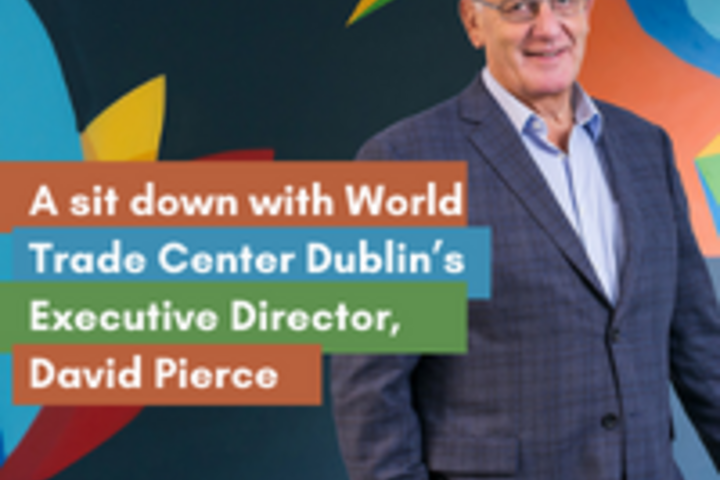
A sit down with World Trade Center Dublin’s Executive Director, David Pierce

With a vast portfolio of international business experience, it is without a doubt that the World Trade Center Dublin’s Executive Director, David Pierce, is a fierce driving force behind the work in helping Irish businesses grow beyond the borders of the Emerald Isle. From assisting young companies in strategizing their export plan, providing unique and tailored opportunities in the enormous China market, and connecting mature exporters to big-box retailers in the U.S., the WTC Dublin certainly has not lacked in activity throughout the pandemic.

Today, we took a few minutes to get a glimpse behind the minds of our operation in hopes of sharing some inspiration on how our small business is growing alongside Ireland’s expanding SME community.

To start with some background, the WTC Dublin is an initiative that began just across the pond in Boston, Massachusetts, and amidst the global community of the World Trade Centers Association, which spans over 100 countries. The WTC Dublin is a family-owned real estate development company, the Drew Company. And yes, the family has deep roots in Ireland and has never strayed far from their origins.

The Drew Company, best known for the development of Boston’s Seaport District with the WTC Boston and Seaport Complex, has always melded their building` projects with vital operational elements that have resulted in thriving commercial and residential buildings. Drew operates the second-largest building in the U.S., the Ronald Reagan Building and International Trade Center, the hub of international activity in the capital of the U.S. The WTC Dublin provides trade services from its location in Dublin’s Merrion Square. As a result, these developments actively play a part in the economic development of the regions in their regions.

Mr. Pierce, can you tell us a little about your journey as an international business executive?

I started as a CPA out of college, which quickly led me into Corporate Banking at Ulster Bank, where I was in corporate lending. I then moved into asset-based lending and the international business world. Under the NatWest International umbrella for Ulster Bank, my role was to sell Ireland internationally but primarily into the U.S. Back then, the FDI coming into Ireland was industrial and manufacturing principally.

My focus was to see what other segments would be attracted to and benefit from locating in Ireland. As we see today, the opportunities were in the tech, financial services, and life sciences business sectors that understood the importance and significance of Ireland’s unique positioning in the European market and the perfect location for a company’s European hub. Ireland had some international presence with Intel and Digital Corporation and a few software companies in the past. In the last ten years, Ireland has solidified our status as the best place to establish a European presence. Today, we have most of the dominant global businesses, including Google, Facebook, LinkedIn, Air BnB, major medical tech, pharmaceuticals, and many more.

Due to my involvement in bringing investment into Ireland, I have always appreciated the value of business relationships. I was appointed President of the Dublin Chamber of Commerce from 2004 to 2005. We ran quite a few critical trade missions that brought Irish and Northern Irish businesses and representatives together with those of Boston and Chicago through the Chamber. I also got an Irish company, NetWatch, a best-in-class proactive video monitoring solutions provider, into the U.S. with their North American Headquarters in Newton, Massachusetts. 

As my U.S. network expanded, it was not long before I was introduced to the Drew Family, starting with their patriarch, John E. Drew. We were of like minds: we both loved to work very hard, and we both value family above all. It was not a difficult connection to make and introduced me to the business of World Trade Centers and understanding this international organization that today has over 300 trade centers in over 100 countries. When the conversation of activating the Drew Company’s WTC Dublin license and its complimenting online platform WebPort Global, I couldn’t think of a better business organization to introduce into Ireland and our SMEs, and I quickly got involved.

What words of advice do you have for an owner/manager of an SME who wants to move his business to the next level?

When we were strategizing about how best to introduce WTC Dublin to Ireland as an international business support organization, one of the areas that we saw as an opportunity was on the export side and specifically for SMEs, especially after the market collapse in 2008-2009. There were many avenues of support for businesses coming into Ireland. Still, the support for SMEs to expand into international markets or even understand the basics of exporting was an area where we saw a great need. We found immediate opportunities in the food and drink sectors around the world and have seen growth in this sector and categories such as apparel, beauty, and home goods. The WTC Dublin focuses on opportunities that get a product(s) onto shelves. The process takes time, patience, and tight margins; however, the reward in volume is superbly higher and one that any brand with a product needs to consider to grow.

If your company is established locally with a good product and solid investment, my advice is to work with WTC Dublin.

Our business services help Irish SMEs overcome barriers to trade in an efficient and accelerated process that will help them through trade difficulties. If not the WTC Dublin, make sure that you are spending the time to receive sound advice, relevant resources for education, and the right contacts that will help you be successful. Lean on organizations like ours dedicated to bringing wins, expanding networks, and infusing innovative ideas and opportunities to your business. Do not embark on an export strategy alone, especially into the U.S. market. You will quickly find that you lack marketing resources, legal advice, and the ability to efficiently move products across the ocean to a market that genuinely is 50 unique markets covering land far more extensive than Ireland’s. And most importantly, remember that it takes a risk to gain a reward.

The other advice I would give an Irish SME owner is to tell your story. One of the unique differentiators of Ireland’s SMEs is the deep history and roots of many of your businesses that go back a few centuries. The historical story coupled with the present-day product is truly a gem that more companies should utilize when marketing their brand globally.

Why should Irish businesses enter into new markets?

First and foremost, the size of the market. Ireland’s population is 5 million, compared to 330 million in the U.S., 212 million in Brazil, 97 million in Vietnam. Secondly, successful businesses have all gone international out of Ireland. Many large Irish companies started their expansion in the U.S.

If you are in the food industry, this is a powerful category for Irish businesses. While the competition may be significant, Ireland is known for its very green culture, including healthy well-sourced foods.

Likewise, the international attraction and demand are high in the drinks industry, especially Irish Whiskey. We have seen tremendous growth in inquiries, especially from the Eastern European and Asian markets, regarding Irish Whiskey.

What is your view of alternative finance options for SMEs looking to export?

If you are going to grow your business, you need funding and finance. Of course, the cheapest financing is getting a loan from a family, but that doesn’t always happen. The critical thing to think about with investment is how much equity you are willing to give away with the investment. Most businesses have found a way to give equity but maintain business control. Is it better to have small shareholders and maintain value or significant shareholders with a loss of equity? With venture capital (VC) funding, the interest rates currently are nil, and cash is abundantly around with VCs looking to spend; however, for SMEs, I caution this space as VCs look for their fair share of the return.

Crowdfunding is an acceptable form of financing; however, for a small business, the initial set up costs may be expensive. With conventional banking options, international invoice financing or invoice discounting is an available option, and trade financing and export financing. However, it would be best if you made sure all your documentation is in place not to jeopardize your funding with these options. 

Going back to investments, there are a few schemes that Irish businesses have used, such as the Employment Investment Incentive Scheme (EIIS), which allows up to €2m in investment from various shareholders investing in your business with a tax break that gets paid back in time. If you are looking at project finance capital expenditure, go to conventional banking. If you are looking for working capital to grow the business, look at the alternatives, i.e., investment or invoice discounting.

How do networks help a business grow?

From my experience, it is all about networking. Business is a contact sport; without contact, you are not making the right connections to achieve a successful goal. Having the right connections with like minds that work together to achieve milestones and goals is the most successful way forward.

If you are just getting started and need to expand your network, start with your local Chamber, local business groups, accounting bodies, legal bodies, and industry-specific organizations. The World Trade Center again is also an excellent global network. For example, the trade centers in France are also all chambers of commerce in their regions. In contrast, many others are government-affiliated trade centers that act as their economic development arm.

These are all excellent connections to have when building your business and essential if you are looking to expand into new markets.

More News

From the Vibrant Irish Coast to the World Stage

March 9, 2026 - The Visionary Journey of Donegal Natural Soap Rooted in the rugged, untamed, naturally beautiful landscape of northwest Ireland and guided by scientific precision, Donegal Natural Soap is more than a skincare brand - it embodies heritage, integrity, and resilience. Founded by bioengineer Isobel Sangha, the company blends nature, innovation, and unwavering quality, using the finest ingredients to create products now reaching customers far beyond Ireland’s shores. What began in a family kitchen has evolved into a growing export business grounded in authenticity and environmental responsibility. Founder Isobel Sangha shares her journey from a home startup to an export-focused skincare brand. About the Business and Founding Story What inspired you to create Donegal Natural Soap, and how has the company evolved since its launch? I grew up surrounded by the landscapes of Donegal — its coasts, mountains, and rural roads. As one of eight children, I spent a lot of my childhood outdoors, learning about local plants, herbs, and wildlife, and gathering hazelnuts, mushrooms, and mussels. That early bond with nature greatly influenced my love for natural ingredients. Although I later studied aeronautical engineering and completed an apprenticeship in the UK, I felt drawn to healthcare. I returned to Trinity College Dublin to earn a master’s in bioengineering and then worked in research and development, gaining experience in clinical design, quality systems, and regulatory compliance. The turning point came when my second son was diagnosed with atopic eczema. I was advised to remove all commercial baby products from his routine, which prompted me to create a simple, natural soap in my kitchen using locally sourced ingredients. Friends and family quickly saw the benefits and encouraged me to approach local retailers. When I researched the market, I discovered that most natural soaps in Ireland were imported from France and Germany, leaving a clear opportunity for an Irish-made product. I began supplying local shops in 2010; fifteen years later, the business has grown steadily, built on quality, integrity, and a loyal customer base. My happy place is walking through the stunning Donegal countryside, drawing inspiration from both the land and the sea. With my bioengineering background, I approach product development with a detailed, scientific mindset. I studied biomimetics — the idea that many solutions to modern problems already exist in nature — which guides how I source and design our products. Donegal itself defines our brand: its purity, ruggedness, and natural beauty are reflected in everything we do. From the ingredients we select to the textures, scents, and packaging, our products tell a story of place, heritage, and sustainability. Additionally, all our products have been palm oil–free since the very beginning in 2010, and in 2018, we became the first Irish company to be Certified Palm Oil Free . Our Donegal roots ensure that every bar of soap carries a sense of authenticity, quality, and environmental responsibility. As a founder in the natural products industry, what challenges did you encounter early on - and what kept you motivated? Running a small business means juggling multiple roles - maker, procurement manager, problem solver, and salesperson. Balancing these responsibilities is challenging. As the business grows, managing employees and increasing production creates even more complexity. What kept me motivated was customer feedback. Hearing people say, “Wow, this has changed my skin,” made all the difference. We’ve faced major roadblocks, including Brexit, COVID, and ongoing global instability. Success requires resilience and the ability to pivot. We have adapted each time and overcome the challenges we have faced. Exporting and International Expansion What motivated you to expand Donegal Natural Soap internationally, and when did you recognize that there was a global demand for your products? After 15 years in business, I have built a loyal and dependable local customer base. Soap is a universal, daily necessity, and my main customers are repeat buyers who genuinely value quality. With this strong foundation, expanding into international markets seemed like the natural next step. I recognized a growing global demand as awareness of environmentally caused skin issues and the need for ingredient transparency increased. While soap is a common product, ours is positioned as a high-quality, natural alternative, with customers often sharing that our products are life-changing for their skin. Hearing that feedback consistently boosted my confidence that Donegal Natural Soap could stand out on a worldwide level. What logistical or regulatory challenges have you encountered internationally, and which markets are showing the strongest response so far? Expanding internationally offers both opportunity and challenges. While the EU is an accessible market, it is highly competitive and constantly changing, especially in the natural skincare sector. Standing out in a crowded market requires effective branding and clear differentiation. With a small team, managing regulatory requirements, tariffs, and customs procedures, particularly in the U.S., can be time-consuming and demanding. Careful planning, strict compliance, and the establishment of strong trade partnerships are crucial to overcoming these hurdles. Regarding market response, we are seeing particularly promising traction in the Nordic countries, where there is a shared appreciation for natural, minimalist, and environmentally friendly products. Germany has also proven to be a strong and receptive market. More broadly, the longstanding international reputation and trust in Irish-made goods continue to positively influence our export strategy. Joining World Trade Center Dublin What inspired you to join World Trade Center Dublin, and what do you hope to achieve through your membership over the next 12–24 months? Having the right people representing your company globally is essential — especially those who understand the nuances of different markets. While I would love to travel extensively, it’s not always feasible. The expertise and network of the World Trade Center Dublin feels like having an extended team that can facilitate international introductions and provide guidance on retail positioning. Over the next 12–24 months, my goal is to build lasting relationships with retailers in key international markets and establish a strong, sustainable export presence. Brand and Product Strategy How does your focus on natural ingredients and sustainability influence your international appeal, and how do you maintain authenticity while adapting to new markets? Our commitment to natural ingredients and sustainability resonates strongly in today’s global market, where consumers are increasingly eco-conscious and skeptical of synthetic-heavy products. There is a growing movement toward zero waste and simplified skincare routines, and bar soap is making a strong comeback as people move away from liquid soaps filled with silicones and artificial oils. In this environment, customers are more informed and eager to support genuine, transparent, and environmentally responsible brands. Maintaining authenticity while growing internationally depends on consistency. We uphold the same high standards we set from the beginning — from sourcing raw materials to managing energy use and reducing waste. In an industry where greenwashing is widespread, transparency is crucial. Customers have the right to know exactly what they're putting on their skin, and we stay true to our original mission by ensuring our products meet both ethical and quality standards, regardless of the market. Leadership and Vision What leadership principles guide you, and what does expansion look like for Donegal Natural Soap in the future? Integrity is at the heart of everything I do. I invest deeply in the business and stay actively involved in all aspects, from challenging suppliers on sourcing and reviewing ingredients to collaborating closely with my team. Donegal Natural Soap has enduring staying power because we have never cut corners. We continue to operate on the same principles I followed when I first experimented in my kitchen — integrity, resilience, and long-term commitment. Looking ahead, I remain focused on strengthening our core product line while exploring new opportunities. One exciting area is developing an oil-based skincare collection that incorporates locally sourced seaweed, partnering with suppliers who share our values. On the international front, we are exploring growth in Asian markets such as Japan and China, where there is strong potential for premium, natural skincare products that align with our commitment to quality and sustainability. What advice would you give Irish SMEs considering exporting? Stay vigilant about your pricing and procurement strategy. In today’s global environment, raw material access, shipping expenses, and currency fluctuations can all be unpredictable, and these changes can quickly affect profit margins. It’s crucial to understand your actual cost structure before entering a new market and to include realistic buffers. Regulatory compliance and logistics are equally important. Each market has its own standards, documentation requirements, and timelines, so doing your research early can prevent costly delays later. Careful forecasting, strong supplier relationships, and flexible planning are essential. Exporting offers great opportunities, but preparation and attention to detail are what make all the difference. Built on Nature, Backed by Science, Ready for the World From foraging along Donegal’s expansive shores to navigating international markets, Isobel Sangha has built Donegal Natural Soap on a foundation of authenticity, science, and sustainability. “Our natural products are designed with a purpose; putting function over form with a holistic care for people and the environment.” With resilience shaped by global challenges and a loyal customer base at home, the company is now poised for thoughtful international expansion. As consumers worldwide seek transparency and environmentally responsible products, Donegal Natural Soap stands ready — rooted in nature, guided by integrity, and prepared for the global stage. Read More

Taking Fresh Flavour Worldwide

February 5, 2026 - Saucery’s Path to International Expansion An exclusive interview with Dirk De Cuyper, Founder of Saucery - covering the brand’s origins, its differentiated growth strategy, and how the World Trade Center Dublin and its global network can support its international expansion. In a global food market traditionally dominated by shelf-stable products, Saucery is establishing a new standard with fresh, chef-made sauces designed for both professional kitchens and discerning consumers. As commercial kitchens face increasing time and labour constraints, flavour and quality remain non-negotiable. Saucery addresses this challenge with chef-crafted finishing sauces made from high-quality ingredients, delivering consistency, efficiency, and restaurant-level results without compromise. Founded by Dirk De Cuyper and shaped by his experience in the food and events industry, Saucery was created to fill a clear and underserved market need. Your journey into food manufacturing is not a traditional one. How did Saucery get started? Before founding Saucery, I spent 15 years running an events business, starting in Miami on private yachts and jets, where food quality was key to every experience we provided. What always caught my attention was the gap between high-quality meals and the sauces people paired with them. Friends would buy top-tier ingredients—like a great steak or carefully sourced produce—and then reach for a sauce that had been sitting on a shelf for years. When I examined the market more closely, I realized that both the US and UK were dominated by ambient sauces made for shelf life rather than flavor. Very little was available that was fresh, chef-made, and chilled. That gap became the foundation for Saucery. What was the core mission behind launching the brand? From day one, our mission has been to bring fresh, restaurant-quality sauces to both food service and home kitchens without compromise. I’ve always believed that “the sauce makes the meal,” and this philosophy is at the heart of everything we do. We aimed to make it simple to elevate everyday meals without the time, skill, or effort usually needed to make sauces from scratch. Saucery is fundamentally chef-driven—centered on the idea of “Fresh from the Chef”—while remaining accessible and convenient for customers. Freshness, taste, quality, and ease of use are at the foundation of the brand and guide every decision we make. How does Saucery stand out in a crowded food market? What’s interesting is that once you look beyond the shelf space, the chilled sauce category isn’t crowded, especially when it comes to branded products. Most sauces are ambient, heavily processed, and designed to last for years. Saucery stands out. Our sauces are fresh, chilled, and naturally preserved, offering a 95-day refrigerated shelf life without artificial preservatives. This makes us a premium choice that aligns with how people cook and eat today. You operate across both food service and retail. Why was that dual approach important? Needs vary, but the core opportunity stays the same. In food service, especially in large-scale catering, operators need consistency, efficiency, and cost control. Making everything from scratch isn’t always practical, and ambient solutions often lack depth and quality. In retail, consumers are cooking better food at home than ever before, but they don’t always have the time or confidence to make sauces themselves. We offer a simple solution that provides professional results with minimal effort. What are your key growth priorities over the next 12–24 months? This is a pivotal period for Saucery. On the food service side, we are close to securing a national wholesaler in the UK, which would open access to hotels, airline catering, and large-scale contract catering operations. In retail, our focus is on advancing discussions with major grocery and premium retail partners, as well as broader engagement with independent and specialty retailers. Trade shows, industry events, and in-market sampling will continue to play a central role in building awareness and driving trial, as tasting is essential for a chilled, fresh product like ours. How are you approaching international expansion? Very deliberate. Our priority is to establish a strong foundation in the UK first. From there, Ireland makes the most sense as the next step — it’s geographically close, culturally aligned, and highly values premium food brands. Beyond Ireland, we’re exploring several European markets, including Benelux, Germany, Poland, and Scandinavia. These regions prioritize quality, convenience, and fresh food. The US is very much part of our long-term plan, but we want to enter that market once our European presence is solidly established. What led you to join World Trade Center Dublin? As an ambitious food brand with international goals, having access to the right networks is essential. World Trade Center Dublin provides market insights, trusted introductions, and local support that can greatly lower the risks of expansion. We recognize the true benefit of accessing local expertise, especially as we explore the Irish market and broader European opportunities. How do you see the World Trade Center network supporting your export plan? Support comes in many forms - from market research and regulatory insight to introductions with distributors and retail partners. Having a global network that understands local nuances allows us to make better decisions and move faster. Ultimately, it’s about collaboration. We don’t just want access; we seek meaningful partnerships that support our sustainable growth. What would success look like for Saucery within the World Trade Center network? Success means entering new markets with confidence and clarity. If we can establish Saucery in Ireland, gain momentum in Europe, and utilize the WTC network to build strong trade relationships, that would be a major achievement. Finally, what is your long-term vision for Saucery as a global brand? Our long-term goal is to build on the strong foundation we’re establishing in the UK and expand that success worldwide. We want Saucery to be recognized globally as the standard for fresh, chef-crafted sauces—products that consistently deliver quality, freshness, and convenience for both professional kitchens and home cooks. As we enter new markets, our focus will remain on preserving the product's integrity while making it easier for chefs and consumers around the world to achieve restaurant-quality results. Ultimately, Saucery aims to become a trusted, go-to brand wherever fresh flavor and efficient execution matter most. Saucery represents a major shift in a category that has traditionally valued shelf life over quality. By providing exceptional, chef-crafted sauces that focus on freshness, consistency, and ease of use, the brand is redefining what both professional kitchens and consumers can expect from everyday flavor. With a targeted growth strategy and clear international ambitions, Dirk De Cuyper is building a business ready to expand across markets while maintaining high standards. Supported by the World Trade Center Dublin and the broader World Trade Center Association network, Saucery’s next growth phase aims to expand its global presence, develop valuable trade partnerships, and deliver fresh, restaurant-quality flavor to communities worldwide. Read More