WTC Mumbai Drives India’s Green Finance Shift

July 16, 2025

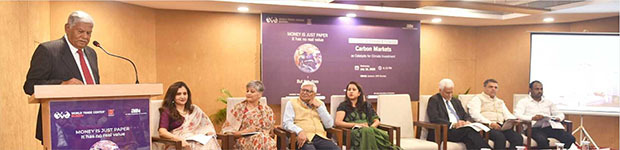
With India racing toward its net-zero targets, a diverse group of stakeholders including industry experts, policymakers, scientists, scholars gathered at the World Trade Center Mumbai for a seminar on “Forests & Finance: Carbon Markets as Catalysts for Climate Investment.”

Jointly organized by MVIRDC WTC Mumbai and the All India Association of Industries (AIAI), the event brought together around 150 participants to explore the emerging potential of carbon markets and forest-based finance in accelerating India’s climate transition.

India is actively developing its carbon market through the Carbon Credit Trading Scheme (CCTS), aiming to reduce greenhouse gas emissions and incentivize sustainable practices. The CCTS, established by the Energy Conservation (Amendment) Act, 2022, introduces both compliance and voluntary mechanisms for carbon trading. The CCTS is designed to help India achieve its updated Nationally Determined Contribution (NDC) of reducing the emissions intensity of its GDP by 45% by 2030 (from 2005 levels) and reaching Net Zero by 2070.

The seminar was aptly timed, taking place just two days after the Union Minister’s announcement of India achieving 50% non-fossil fuel capacity in 2025. It is a significant milestone in the country’s clean energy transition, and a clear signal that nature-based solutions like forest conservation and carbon markets must now play a central role in achieving net-zero goals.

In his opening remarks, Dr. Vijay Kalantri, Chairman of MVIRDC WTC Mumbai and President of AIAI, welcomed speakers and participants, underlines the need for consistent climate policies and long-term vision. "India has an incredible natural capital in its forests. What we need is to align this with real financial value so both ecology and economy thrive together” he said. Further he emphasized that carbon credits are a crucial tool in this, as they represent a tangible reduction in emissions, making climate action a tradable asset that incentivizes vital investments in our green future.

Ms. Priya Pansare, Director, Trade & Investment Promotion, WTC Mumbai welcomed all dignitaries and set the tone for the seminar by highlighting the urgent need to integrate forests into India’s climate finance strategy.

India’s Forest Potential Meets Market Opportunity

India’s forest cover spans nearly 81 million hectares- around 24.6% of its land and acts as a massive carbon sink. However, speakers agreed that this potential is still largely untapped in the financial system.

Experts pointed to new initiatives such as the Carbon Credit Trading Scheme (CCTS) and the Green Credit Programme (GCP), which are laying the groundwork for a national carbon market. So far, over 360 million carbon credits have been issued in India. But challenges persist particularly around unclear carbon ownership, delays in regulatory rollouts, and lack of community recognition under the Indian Forest Act.

Speakers noted that small businesses and startups are well-positioned to play a key role especially in areas like monitoring, reporting, and verification (MRV), agro forestry, and state-level models such as the one in Uttar Pradesh. Still, panelists emphasized that these efforts will only scale if they overcome hurdles like financing, verification bottlenecks, and ensuring meaningful community involvement.

Highlights from Key Speakers:

Mr. Arvind Kumar Jha, former PCCF of Maharashtra, warned of severe consequences of climate inaction from disrupted monsoons to food insecurity and urged stronger implementation of carbon trading systems.

Dr. Rohini Chaturvedi, strategic advisor on forest governance, raised concerns about the under-financing of forest ecosystems and stressed the importance of ecological and social integrity in carbon markets, including upholding the Forest Rights Act.

Mr. Swapan Mehra, CEO of IORA Ecological Solutions, called forests “GDP contributors,” pointing to their impact on clean air, water, and climate regulation. He urged more blended finance solutions and larger-scale restoration investments.

Ms. Ashwini Hingne of WRI India spoke about how carbon markets can create new revenue opportunities for MSMEs if structured to ensure additional, measurable, and permanent emissions reduction. She also discussed about robust domestic carbon markets can help industries adapt while staying globally competitive.

Dr. Pradeep Reddy Punnam of IIT Bombay explained the science and economics behind nature-based carbon dioxide removal (CDR) solutions like biochar, agroforestry, and enhanced rock weathering, calling them viable and cost-effective alternatives to expensive tech-based CCUS methods.

Experts at the seminar called for the urgent need to financially unlock India's vast forest potential to meet net-zero targets. Speakers emphasized that stronger implementation of carbon trading systems and innovative financing are crucial to scale nature-based solutions. They also noted the potential for MSMEs in carbon markets and the importance of ecological and social integrity in these systems. Finally, experts called for greater coordination and education to accelerate climate investments through carbon markets.

Way Forward

The seminar closed with clear takeaways:

l  Build stronger coordination between state and national agencies on carbon programs.

l  Educate MSMEs and investors about nature-based solutions.

l  Scale up projects from 50 to 5,000 hectares to attract institutional finance.

l  Improve data systems and simplify community engagement processes.

As India accelerates toward its 2070 net-zero goal, the role of forests and carbon markets will only grow more central. Events like this are vital in turning climate potential into climate action.

More News

India–Norway Focus on Energy & Investment Ties

March 6, 2026 - World Trade Center Mumbai, in association with the All India Association of Industries (AIAI)and the Royal Norwegian Consulate General in Mumbai, successfully organized an International Trade Dialogue with Norway. This event brought together government representatives, industry leaders, and trade stakeholders to explore opportunities for strengthening India–Norway economic cooperation, particularly in sustainable energy, maritime innovation, and green technologies. The event was attended by H.E. Ms. Monica Nagelgaard, Consul General, Royal Norwegian Consulate General, Mumbai, reflecting the importance of India–Norway bilateral engagement. Mr. Fredrik Bjerke Abdelmaguid, Deputy Consul General, Royal Norwegian Consulate General, Mumbai, highlighted “Norway is keen to deepen economic engagement with India and expand cooperation across clean energy, sustainable maritime solutions, and innovation-driven sectors.” “The complementarities between Norwegian technological expertise and India’s growing industrial and entrepreneurial ecosystem align strongly with the India–EFTA TEPA framework. The USD 100 billion investment commitment under EFTA over the next 15 years represents a significant boost to bilateral cooperation.” added Mr. Fredrik Dr. Vijay Kalantri, Chairman, World Trade Center Mumbai and President, All India Association of Industries, said, “With India aiming to achieve Net Zero emissions by 2070 and targeting 500 GW of non-fossil fuel energy capacity by 2030, partnerships with countries like Norway, which are global technological leaders play a key role. Beyond clean energy, there is also significant potential for cooperation in sectors such as pharmaceuticals, maritime equipment, shipping technologies, and chemicals, where both countries can leverage their complementary strengths to expand trade and industrial collaboration.” Dr. Kalantri added, “Bilateral trade between India and Norway has crossed USD 1.2 billion, and with the India–EFTA Trade and Economic Partnership Agreement (TEPA), which came into effect after nearly 16 years of negotiations, there exists strong potential to significantly double the trade in the coming years.” Ms. Reena R Rao, General Manager, Mahatma Phule Renewable Energy and Infrastructure Technology Limited (MAHAPREIT), a subsidiary of MPBCDC, Government of Maharashtra, said “MAHAPREIT plays a vital role in promoting solar energy, green technologies, and inclusive infrastructure development to drive socio-economic empowerment. She further highlighted MAHAPREIT’s core verticals, including renewable energy and electric vehicles, agro-processing and biofuels, infrastructure and data centre development, as well as CSR-led initiatives, aimed at fostering sustainable and inclusive growth.” “MAHAPREIT continues to serve as a key facilitator in aligning Maharashtra’s clean energy ambitions with community-led development through strategic partnerships and innovative projects.” added Ms. Reena Mr. Azam Ali Khan, Senior Energy Advisor for India, NORWEP (Norwegian Energy Partners), said “There are emerging opportunities for collaboration in offshore energy, green transition technologies, and sustainable industrial practices. Strengthening partnerships between Norwegian companies and Indian enterprises, particularly MSMEs, can accelerate the adoption of energy-efficient solutions and contribute meaningfully toward achieving global climate goals.” The session also included an interactive Q&A session, enabling participants to engage directly with speakers and discuss practical pathways for enhancing bilateral trade, investment, and technology cooperation. The programme concluded with a Vote of Thanks deliveredby Capt. Somesh Batra, Vice Chairman, World Trade Center Mumbai, who acknowledged the Norwegian delegation and participants for contributing to a meaningful exchange of ideas and reaffirmed WTC Mumbai’s commitment to promoting international trade dialogue and economic collaboration. Read More

WTC Mumbai Strengthens Sri Lanka Trade Links

February 17, 2026 - World Trade Center Mumbai, in association with the All India Association of Industries (AIAI), hosted a business delegation from Sri Lanka to strengthen bilateral trade, investment cooperation, and industry partnerships between the two countries. The programme focused on enhancing commercial engagement across key sectors including textiles and apparel, handicrafts, lifestyle products, wellness industries, infrastructure, tourism, and IT services. The interaction facilitated over 300 B2B meetings between Indian and Sri Lankan companies, highlighting new opportunities for collaboration, market access, and supply chain integration Ms. Shirani Ariyarathne, Consul (commercial), Consulate General of Sri Lanka, said “India and Sri Lanka share a deep-rooted relationship that goes back millennia. We already have a Free Trade Agreement in goods, and we are now looking to expand cooperation through a Free Trade Agreement in services, which will further strengthen our economic integration. There are significant opportunities in tourism, textiles, automobiles, infrastructure development, and IT, and we are also exploring the further expansion of industrial zones to facilitate greater business engagement. With Sri Lanka offering preferential market access and a rapidly growing economy, the prospects for enhanced bilateral collaboration are extremely promising.” Dr. Vijay Kalantri, Chairman, World Trade Center Mumbai and President, All India Association of Industries, said “Since the Free Trade Agreement, India and Sri Lanka have come a long way in strengthening their economic partnership. Bilateral merchandise trade between the two countries has crossed USD 6 billion in FY 2024–25, and we expect this to double over the next five years. With nearly 4,000 products enjoying tariff concessions, there is significant scope to expand trade beyond traditional sectors. In this evolving geopolitical environment, strengthening regional partnerships is essential to ensure economic resilience and shared prosperity.” “There is high potential for collaboration in sectors such as textiles and apparel, pharmaceuticals, automobiles, agriculture and food processing, IT and digital services, renewable energy, and tourism. India remains one of the largest contributors to foreign direct Investment in Sri Lanka, reflecting strong business confidence and the long-term potential of the bilateral partnership. We are proud to be hosting our sixth delegation from Sri Lanka in the past six months, which reiterates the growing momentum in India–Sri Lanka engagement,” added Dr. Kalantri. Mrs. Mangala Madhuwanthi, Export Development Board Sri Lanka, said “The Sri Lanka Export Development Board plays a vital role in promoting the country’s export sector, with total exports exceeding USD 17.3 billion last year, including USD 13.6 billion in merchandise trade, these exports contribute nearly 19% to GDP. The delegation visiting today represents this diversity with companies from lifestyle, leather, wellness, renewable paper, handicrafts, and traditional batik products, and creative industry products showcasing Sri Lanka’s rich heritage and export capabilities”. The programme concluded with a Vote of Thanks by Capt. Somesh Batra, Vice Chairman, World Trade Center Mumbai, who expressed appreciation to the visiting delegation and participants for contributing to meaningful dialogue and strengthening economic bridges between India and Sri Lanka. He added that by partnering with Sri Lankan enterprises, Indian companies can leverage complementary strengths and access wider regional markets. Read More